Validation plan
110 loads
Proposed testing the AI Summary across real managed-execution shipments to validate accuracy, edge cases, and grounding in structured data.
Designed an AI tracking summary feature to help customers quickly understand shipment status, ETA, risk, and next steps.

Many operational signals collapsed into one customer-facing update.
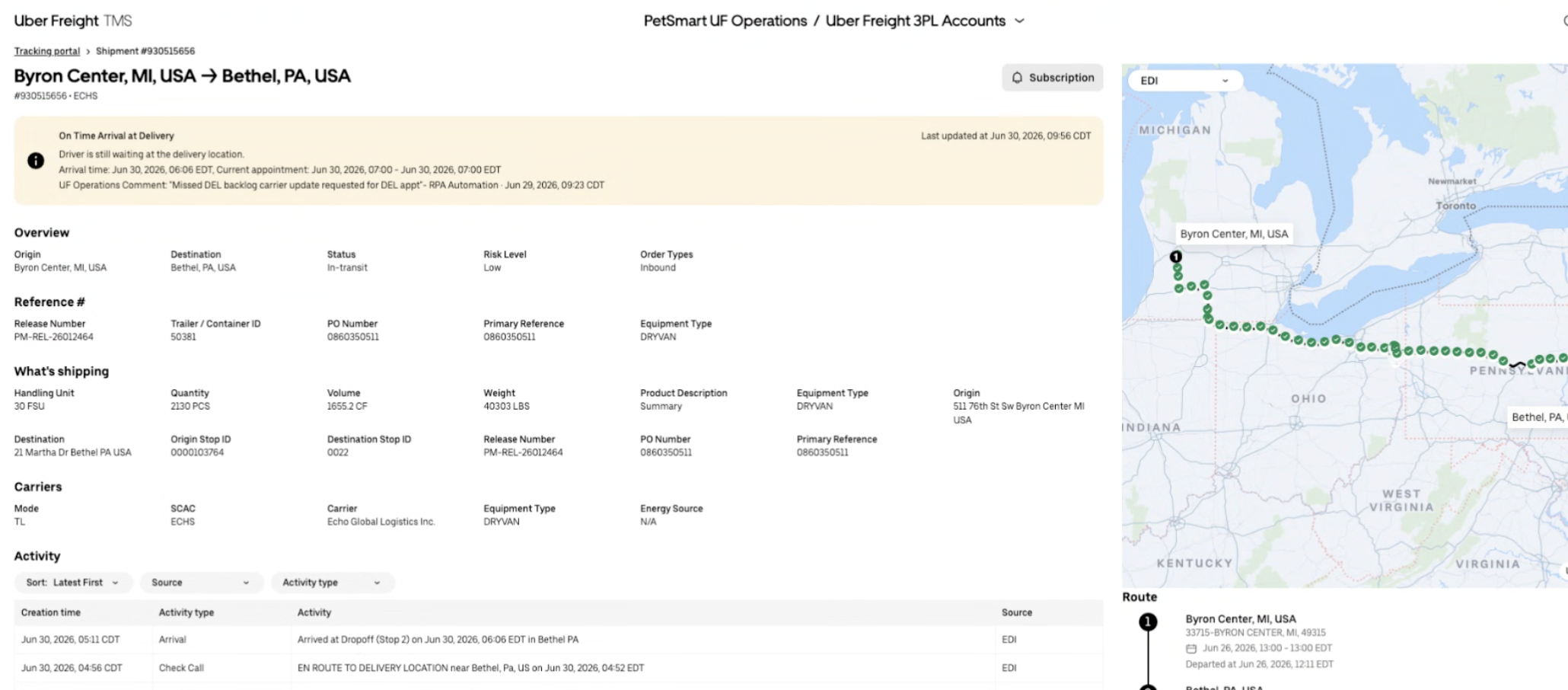
Before
Validation plan
110 loads
Proposed testing the AI Summary across real managed-execution shipments to validate accuracy, edge cases, and grounding in structured data.
States supported
6+
Defined behavior for On Track, Potential Delay, Appointment Missed, Stale Tracking, Awaiting Carrier Update, Facility Delay/Detention, and Delivered.
Customer outreach
Lower
Designed the summary to reduce avoidable 'where is my shipment?' inquiries by consolidating ETA, location, risk, and next-step context.
I led customer and ops discovery, prompt requirements with Eng, and early experience design for the AI Summary concept.
I partnered with product, engineering, design, and operations stakeholders to define the summary’s input data, output structure across shipment scenarios, and validation against 100+ loads.
Backend feasibility, structured payload design, AI endpoint behavior, caching logic, feature flags, timeout handling, and deterministic fallbacks.
Opportunity framing, AI Summary scope, customer-facing goals, and MVP requirements.
Placement, hierarchy, and how the summary fit with the rest of the tracking portal.
Shipment investigation workflows and operator feedback to shape useful summary language.